

Artistic Jewelry for Modern Collectors: A 2026 Guide
Table of Contents
- What Defines Artistic Jewelry in the Modern Market
- Why Artistic Jewelry Has Become a Collector's Focus
- How to Style Statement Jewellery with Intention
- Caring for Artisan Gemstone Pieces
- Investing in Handmade Jewellery: What Matters
- Building a Curated Collection of One-of-a-Kind Pieces
- Conclusion: The Lasting Appeal of Artistic Jewelry
- Frequently Asked Questions
Last Updated: September 5, 2026
Artistic jewelry is more than an accessory; it is a wearable form of personal expression that bridges the gap between fine art and daily life. For modern collectors, artistic jewelry represents a shift away from mass-produced ornamentation toward pieces that carry meaning, narrative, and a distinct design philosophy. At Choux Fleur Designs, we believe this movement reflects a deeper desire for authenticity, where each handcrafted creation offers a unique visual language that cannot be replicated. This guide explores how to identify, style, and invest in these modern heirlooms, offering practical advice for both new admirers and seasoned collectors.
What Defines Artistic Jewelry in the Modern Market
Artistic jewelry is defined by its emphasis on creative vision over conventional ornamentation, prioritising sculptural forms, mixed media, and material innovation. Unlike traditional fine jewelry focused solely on precious metals and gemstone value, this category treats the body as a canvas for artistic expression.
Several characteristics distinguish artistic jewelry in today's market:
- Design philosophy: Each piece stems from a coherent concept or narrative
- Craftsmanship: Handcrafted techniques that celebrate the maker's hand
- Limited production: Small batches or one-of-a-kind creations that reject repetition
- Material exploration: Unconventional combinations of artisan gemstone and mixed media
The most compelling contemporary jewelry balances aesthetic boldness with everyday wearability. A statement piece should feel intentional, not costume-like, and its craftsmanship must withstand the test of daily wear.
Why Artistic Jewelry Has Become a Collector's Focus
Collectors are increasingly drawn to artistic jewelry because it offers something mass production cannot: genuine scarcity and a direct connection to the maker. In an era of identical accessories, the desire for individual expression has made handcrafted pieces a meaningful focus for those building a curated collection.
From Adornment to Wearable Art
The evolution from simple adornment to wearable art marks a significant cultural shift. Historically, jewelry signalled status or wealth; today, it communicates taste, values, and personal history. Modern collectors seek pieces that function as miniature sculptures, carrying an artistic legacy that transcends trends. This transition has elevated independent designers, whose avant-garde approaches challenge conventional notions of what jewelry should be. For many, acquiring such a piece is an act of patronage, supporting the continuation of a design philosophy that values innovation and authenticity over mass appeal.
How to Style Statement Jewellery with Intention
Styling statement jewellery successfully comes down to balance and confidence. The piece should anchor your outfit, not compete with it, allowing the craftsmanship and colour to speak clearly.
A common mistake is pairing bold sculptural jewelry with equally busy clothing. Instead, let the jewelry lead:
- Choose neutral or solid-toned garments that provide a quiet backdrop
- Layer one statement piece with delicate, minimalist items for contrast
- Consider proportion: a large pendant suits an open neckline, while sculptural earrings frame the face
- Match the piece's energy to the occasion, from casual linen to evening silk
For those new to artistic pieces, start with one element, such as a gemstone pendant, and build your confidence. The goal is to wear the art, not to let it wear you.
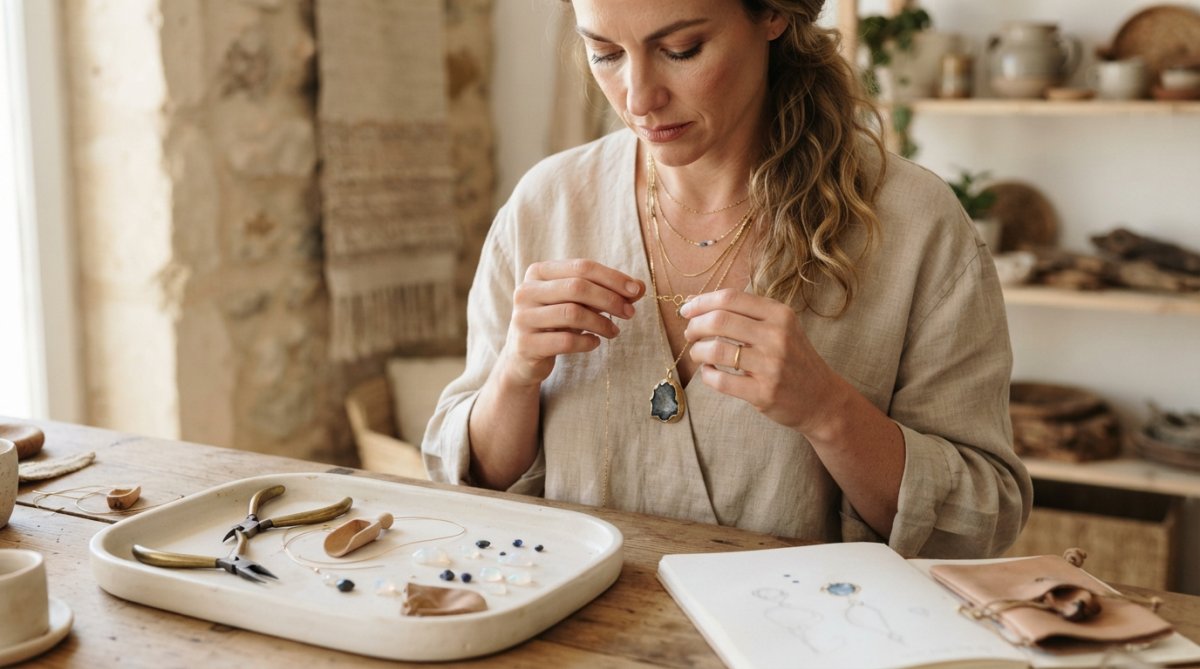
Caring for Artisan Gemstone Pieces
Most mainstream advice assumes your jewellery is made of diamond, gold, and platinum. Artistic jewelry, however, frequently incorporates materials that demand a different kind of stewardship. Resin, reconstituted stone, raw minerals, oxidised silver, and organic elements like wood or seed pods each have their own vulnerabilities. Treating them like traditional fine jewelry is the fastest way to damage them.
The Non-Traditional Material Problem
A piece with a high-polish resin inlay can cloud permanently if exposed to acetone or alcohol-based sanitisers. Oxidised silver, prized for its darkened, sculptural contrast, will wear away to bright silver on high-friction areas like cuffs or rings, a natural ageing process some collectors love, but one you should anticipate. Raw, unsealed turquoise or malachite is porous and will absorb skin oils, altering its colour over time (minerals.net). Before you buy, ask the maker two questions: What is this material sensitive to? and What is the intended lifespan of this finish?
A Practical Care Protocol for Mixed Media
- Daily wear: Remove pieces before applying lotions, perfumes, or hand sanitiser. Let these products dry completely before putting your jewellery on.
- Cleaning: For mixed-metal and stone pieces, use a soft, dry microfibre cloth only. For pieces with resin or organic components, avoid water entirely, wipe with a slightly damp cloth and dry immediately. Never use ultrasonic cleaners or steamers unless the maker has explicitly confirmed every material in the piece can withstand them (gia.edu).
- Storage: Store pieces individually in soft pouches or compartmentalised boxes. Do not let sculptural pieces touch, as protruding elements can scratch or snag. For oxidised silver, storing with a silica gel packet in an airtight bag slows the re-oxidation process.
- Climate considerations: The Australian climate presents two distinct threats: intense UV in summer and high humidity in tropical zones. UV will fade dyed agate, certain pearls, and some polymer clays (ganoksin.com). Humidity can corrode base metals used in mixed-media findings. Store your collection away from direct window light, and consider a small dehumidifier for a wardrobe if you live in a coastal or tropical area.
When to See a Professional
If a stone becomes loose or a setting bends, do not attempt a DIY fix. Take the piece to a jeweller experienced in art jewellery or, ideally, back to the original maker. Many independent designers offer repair services for their own work, and some will re-oxidise silver or re-polish resin for a nominal fee. Establishing this relationship at the time of purchase is one of the most practical steps a collector can take.
Investing in Handmade Jewellery: What Matters
Investing in handmade jewellery is not like buying a blue-chip stock. The market is opaque, illiquid, and driven by a different set of value signals. Understanding those signals separates a collector who buys with intention from one who simply accumulates objects.
The Value Equation Beyond Materials
While traditional fine jewellery value is anchored to gold weight and diamond carat, artistic jewellery value is anchored to three factors: the artist's career arc, the piece's position within that arc, and provenance. A piece from an artist's early experimental period, before they gained gallery representation, can become far more desirable as their career matures. Conversely, a technically perfect but derivative piece from a lesser-known maker may never appreciate.
The Secondary Market: A Realistic View
Unlike mass-produced luxury goods, contemporary art jewellery has no central marketplace. Resale happens through auction houses with dedicated craft departments, specialist dealers, or private sales. This means liquidity is low, you cannot sell a piece in an afternoon. However, this illiquidity also protects the market from the speculative bubbles that affect other collectibles.
What actually drives resale value in this sector?
- Exhibition history: A piece exhibited in a major gallery or museum show carries a documented pedigree that private commissions lack.
- Awards and grants: Makers who win recognised industry awards, such as those from the Jewellers Association of Australia, gain a measurable credibility marker.
- Limited editions: Numbered editions from established artists create scarcity. A piece marked '1/10' will always command more interest than an open edition.
- Condition and documentation: Original receipts, artist statements, and certificates of authenticity are not paperwork, they are the provenance that makes a piece verifiable to a future buyer.
The Patronage Model
A more sustainable approach for most collectors is to view acquisition as patronage rather than speculation. When you buy directly from an independent designer, you fund their next body of work. Many serious collectors build relationships with three or four makers over a decade, buying one piece every year or two. This approach yields a collection with internal coherence and a documented narrative, qualities that matter deeply if you ever decide to sell the collection as a single lot.
Practical Due Diligence Before You Buy
- Ask the maker about their studio practice: do they work alone or with assistants?
- Request a written description of materials and techniques, this becomes part of your provenance file.
- Check whether the maker has exhibited in public institutions or only sold through their own website.
- Understand the difference between a 'one-off' and a 'unique piece', in some makers' vocabularies, these mean different things.
By applying this lens, you move beyond decoration and into a genuine collecting practice, where each acquisition is a considered act of cultural preservation.
Building a Curated Collection of One-of-a-Kind Pieces
Building a curated collection of one-of-a-kind pieces is a personal journey that rewards patience and a clear eye. Rather than acquiring many items, focus on selecting works that resonate with your evolving taste and complement each other in form and colour.
A thoughtful approach involves:
- Defining your aesthetic preferences, from minimalist to avant-garde
- Researching independent designers whose design philosophy aligns with yours
- Prioritising quality and wearability over quantity
- Allowing your collection to develop organically as your style matures
For many collectors, the psychology of collecting is driven by the joy of discovery and the satisfaction of owning something truly singular. Each piece becomes a chapter in a personal story, a tangible memory of a moment, a place, or an artistic encounter. As your collection grows, you will find that the most rewarding pieces are those that feel like natural extensions of yourself, meant to be worn every day and cherished forever.
Conclusion: The Lasting Appeal of Artistic Jewelry
Artistic jewelry for modern collectors offers a meaningful alternative to the disposable trends of fast fashion, grounding personal style in craftsmanship and intention. Building a collection takes time, but the reward is a wardrobe of pieces that hold both aesthetic and emotional value. Choux Fleur Designs embodies this philosophy, creating small-batch, one-of-a-kind gemstone jewellery handcrafted in Australia. Each piece balances colour, proportion, and contrast to deliver a unique expression designed for daily wear and lasting appreciation. Explore the collection and find a modern heirloom that speaks to your own artistic sensibilities.
Frequently Asked Questions
What defines artistic jewellery in the modern market?
Artistic jewellery prioritises design vision and craftsmanship over mass appeal. These pieces often feature sculptural forms, unusual material combinations, and bold colour palettes that set them apart from commercial fine jewellery. Modern collectors look for originality, provenance, and the maker's distinct visual language. Unlike costume jewellery, artistic pieces are typically handcrafted in small batches using quality materials, which means they hold their value and withstand daily wear. The result is wearable art designed to be a lasting part of your personal expression.
How do you start a collection of handcrafted gemstone jewellery?
Begin with a piece that genuinely reflects your aesthetic rather than chasing trends. Look for an artisan whose design philosophy resonates with you, and consider how their work complements your existing wardrobe. Start with a versatile statement piece or a daily-wear ring in a gemstone you love. Ask about the maker's process, material sourcing, and production methods. Many Australian designers work in small batches, so you can request details about durability and care before committing. A focused approach helps you build a meaningful collection over time.
What makes a piece of jewellery a 'modern heirloom'?
A modern heirloom combines enduring design with honest materials, created to be worn regularly and kept for decades. Unlike trend-driven accessories, these pieces are designed without planned obsolescence. The maker's signature, the quality of the gemstone setting, and the structural integrity of the piece all contribute to its longevity. Small-batch production means your piece is genuinely unique. When you invest in artistic jewellery, you are choosing an object with provenance and intention, one that can be passed down with a story attached.
How should you care for unique, small-batch gemstone jewellery?
Treat artisan pieces with the same care you would give fine jewellery. Remove rings and bracelets before swimming, cleaning, or applying lotions and perfumes. Store pieces separately in soft pouches to prevent scratching, as gemstones vary in hardness. Clean gently with a soft, damp cloth and mild soap, avoiding ultrasonic cleaners unless the maker confirms they are safe. Regular inspection of clasps and settings helps catch wear before it becomes a problem.
This article was written using GrandRanker