

Handcrafted Gemstone Jewelry for Women: 2026 Guide
Table of Contents
- Why Handcrafted Gemstone Jewelry for Women Stands Apart
- A Quick Comparison of One-of-a-Kind Necklaces
- Artistic Jewelry for Modern Collectors: What to Look For
- Gemstone Durability and the Mohs Scale
- Caring for Natural Gemstone Jewellery
- How to Style Gemstone Rings and Necklaces
- Ethical Sourcing and Sustainability Certifications
- Frequently Asked Questions
Last Updated: September 13, 2026
Why Handcrafted Gemstone Jewelry for Women Stands Apart
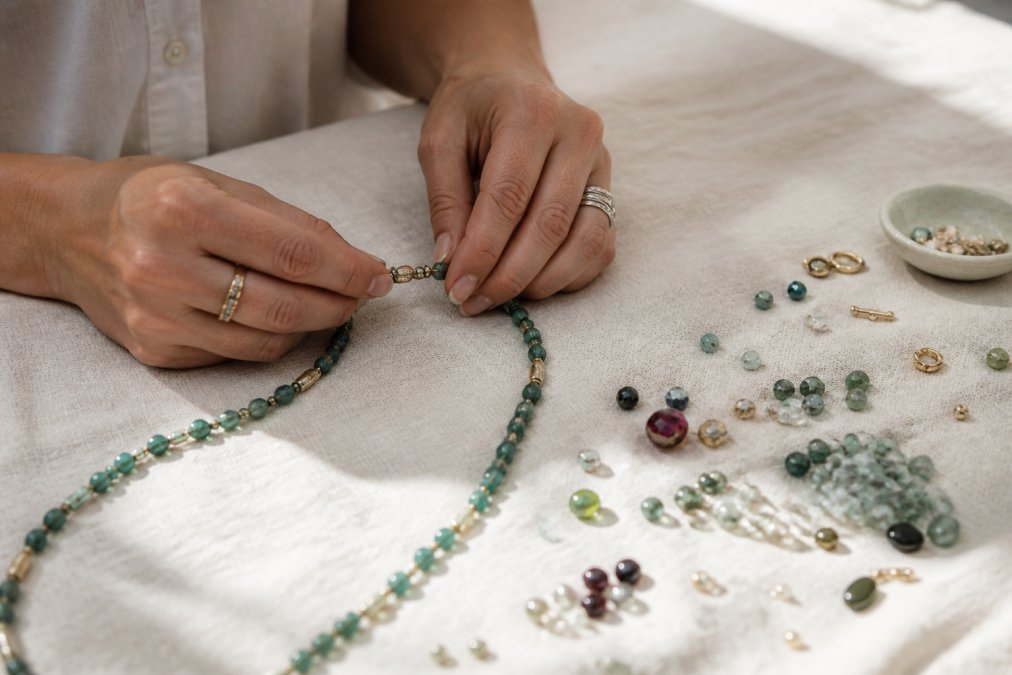
Handcrafted gemstone jewelry for women is assembled by hand in small batches, with each stone selected individually rather than machine-sorted into identical sets. At Choux Fleur Designs, every necklace is strung one bead at a time, so no two pieces match. Hold two mass-produced necklaces side by side and you'll see identical colour, spacing and flaws.
The appeal of gemstone jewelry runs deeper than aesthetics: a hand-strung piece carries the maker's decisions, which stone sits next to which, where the gold spacers fall, how the strand sits at the collarbone. A factory line cannot replicate that.
Below: what changes in small-batch production, how to judge durability, and how to style a piece you'll actually wear.
Small-Batch vs Mass-Produced: What Changes
Mass production optimises for uniformity; small-batch work optimises for individuality. That trade-off affects everything from stone quality to how long a piece lasts.
Buyers often assume "handmade" means "delicate." It usually means the opposite: hand-stringing lets a maker reinforce the thread, choose a stronger clasp, and reject stones with hairline fractures that a machine would string anyway.
Mass-produced gemstone jewelry is calibrated for uniform beads that photograph well but lack natural variation. A handcrafted strand, by contrast, looks slightly different in every light, and that's the point.
A Quick Comparison of One-of-a-Kind Necklaces
One-of-a-kind necklaces are strung from a single, unrepeatable combination of stones, so the piece you buy cannot be restocked or duplicated. You're not choosing between sizes of one design but between five different design decisions. The table below compares five current designs across price, stone mix and length.
| Piece | Price | Stone Mix | Length | Best For |
|---|---|---|---|---|
| Blythe | $69.95 | Mixed gemstones, earthy tones | 58cm | Layering |
| India | $79.95 | Indian agate | 49cm | Grounded, everyday wear |
| Stevie | $79.95 | Lapis, carnelian, jasper | 54cm | Bold statements |
| Lila | $79.95 | Dalmatian jasper | 45cm | Subtle daily wear |
| Maya | $89.95 | Blue sponge quartz, pearls | 53cm | Cool-toned elegance |
Blythe sits longest, making her the natural choice for layering over a fine chain. India runs shorter and reads more formal. Lila, at 45cm, is the quietest and easiest to wear with a work wardrobe.

How to Read the Table Before You Buy
Price differences track stone rarity and bead size more than length. Maya tops the range because blue sponge quartz is harder to source in consistent beads and the pearls add a second material. Stevie and India cost the same despite different stone counts because lapis, carnelian and jasper are all readily available in the sizes used.
Length is the variable most buyers underestimate. Measure a necklace you wear often and note the number: anything within 5cm of that baseline feels familiar, anything beyond feels like a deliberate change. Between two lengths, the shorter layers more easily and the longer makes more of a statement alone.
Stone mix is the third decision. A single-stone strand like India or Lila pairs easily with patterned clothing because it introduces one colour rather than several. A mixed strand like Stevie or Blythe does more work alone but competes with busy prints. Solid-colour wardrobes suit mixed strands; patterned wardrobes suit single-stone pieces.
What the Prices Do and Do Not Tell You
At this price band you're paying for stone selection and hand assembly, not precious metal weight.
What price doesn't tell you is how a strand will sit on you. A 45cm piece reads shorter on a taller frame, and a 58cm piece on a petite frame can sit closer to the waist than intended. Use the lengths as a guide, then check against your own baseline measurement before committing.
Restocking and Availability
Because each piece is one of a kind, a sold-out design doesn't return in the same form. The next strand built from similar stones will differ in tone, bead size and spacing. That's the trade-off of small-batch work: individuality, but no waiting for a restock. If a piece matches your wardrobe and baseline length, buy rather than bookmark.
Artistic Jewelry for Modern Collectors: What to Look For
Artistic jewelry for modern collectors is judged on three things: colour, proportion, and contrast. Get those right and a piece works with almost anything you own.
Colour is where most buyers hesitate online, and understandably so. Screens shift tones, and a stone that looks sage green on a monitor can read greyer in daylight. Reputable makers photograph in natural light and note that natural stones vary, so expect slight differences rather than a perfect match.
Proportion matters more than people realise: 10mm beads at 45cm sit very differently from the same beads at 58cm. Petite frames balance better with shorter strands and smaller beads; taller frames hold visual weight with longer strands and larger beads.
Contrast is the collector's secret. Mixing warm and cool stones, or matte and polished finishes, reads as intentional; every bead the same tone reads as flat.
Colour, Proportion and Contrast
Start with your wardrobe's dominant tones. If you wear lots of neutrals, a colourful array of mixed stones supplies the missing contrast. If your wardrobe is already saturated, choose a piece built around one stone family so it doesn't compete.
For proportion, measure a necklace you wear often and note its length, that's your baseline. Anything within 5cm feels familiar; anything beyond feels like a deliberate statement.
Gemstone Durability and the Mohs Scale
The Mohs scale rates mineral hardness from 1 (talc) to 10 (diamond) and is the best predictor of how a stone survives daily wear (britannica.com). Most necklace gemstones sit between 6 and 8.
Quartz, including crystal quartz and amethyst, rates 7 (mindat.org). Agate and jasper, both chalcedony, sit at 6.5 to 7 (mindat.org). Lapis lazuli is softer at 5 to 6, and pearls softest at around 2.5 to 4.5. A pearl necklace worn daily against rough fabric will dull faster than a jasper strand.
Hardness governs scratching, not breakage. A softer stone in a necklace is usually fine because it isn't knocking against hard surfaces the way a ring is. Durability genuinely matters for rings and bracelets, which take far more contact.
Caring for Natural Gemstone Jewellery
Caring for natural gemstone jewellery comes down to four habits: keep it dry, keep it away from chemicals, store it out of sunlight, and wipe it after wear. That routine takes under a minute and prevents most damage people blame on "cheap stones."
The two biggest risks are water and perfume. Water weakens the thread over time and dulls polished surfaces; perfume and lotion leave residue that builds up between beads.
- Remove before showering, swimming, or exercising
- Apply perfume and lotion before putting the piece on, never after
- Store in a dry pouch or jewellery box, away from direct sunlight
- Wipe gently with a soft dry cloth after each wear
- Check the clasp and thread every few months for looseness
Most people spray perfume then reach for their necklace. Reversing that one habit does more for a strand's lifespan than any cleaning product.
How to Style Gemstone Rings and Necklaces
How to style gemstone rings and necklaces depends on one rule: let one piece lead. If the necklace is the focus, keep rings minimal; if rings are the focus, choose a quieter strand. The neckline, occasion and metal tone all change what actually works.
For necklaces, the neckline decides. A V-neck or scoop neck leaves space for a shorter strand at the collarbone; a high neck or turtleneck suits a longer strand worn over the fabric; an open shirt collar suits a mid-length piece just below the collarbone.
For rings, stacking works when stones share a colour family. A single gemstone ring with a plain band reads more refined than three competing stones on one hand.
Matching Pieces to Necklines and Occasions
A 45cm strand like Lila sits at the collarbone and suits a round or boat neck. A 53cm piece like Maya falls just below it, flattering a V-neck. Longer strands, including Blythe at 58cm, can be worn over a fine knit or layered with a shorter chain.

For occasions, the calculus is simple. Everyday wear rewards smaller beads and muted tones. Evening wear rewards contrast, so a piece with clear crystal accents catching the light will do more work than a monochrome strand.
A Neckline-by-Neckline Styling Guide
This is the part most jewellery pages skip, and it decides whether a piece gets worn.
- V-neck: A strand that ends in the V, roughly 45cm to 50cm, fills the space without crowding it. A pendant or a single-stone drop works here because the eye follows the neckline down.
- Scoop neck: Similar to a V-neck but wider, so a slightly longer strand at 50cm to 55cm balances the open curve. Avoid a choker-length piece, which can look pinched against the wider opening.
- Round or boat neck: The collarbone is the focal point, so a 45cm strand sits exactly where it should. This is the easiest neckline to style and the one most pieces are photographed against.
- High neck or turtleneck: Wear the strand over the fabric, not tucked under it. A longer piece at 55cm to 60cm creates a vertical line that stops the high neck from reading as heavy.
- Open shirt collar: A mid-length piece at 50cm to 55cm falls just below the collar points. Keep the beads smaller here so the collar stays the dominant shape.
- Strapless or off-shoulder: The neck and shoulders are bare, so a shorter, more detailed piece at 40cm to 45cm draws the eye upward. This is the one neckline where a bolder stone mix earns its place.
Occasion Styling: Day, Work, and Evening
Daytime wear rewards restraint: smaller beads, muted tones and a single-stone mix sit comfortably against casual fabric without competing with a bag strap or scarf. A 45cm to 50cm strand in agate or jasper is the workhorse of a daytime wardrobe.
Workwear rewards proportion over colour. A mid-length strand at 50cm to 55cm in a single stone family reads considered rather than decorative and layers cleanly under a blazer. In conservative workplaces, keep the metal tone consistent with your other jewellery; mixing silver and gold is a deliberate choice, not a neutral one.
Evening wear rewards contrast. A mixed-stone strand or a piece with pearls and quartz does the most work because low light flattens subtle colour differences; clear or reflective stones catch ambient light and read brighter than matte monochrome. For a special occasion, contrast beats subtlety every time.
Metal Tone and Layering
Sterling silver and gold-filled findings each change how a gemstone reads. Cool-toned stones such as lapis, blue sponge quartz and dalmatian jasper sit naturally with silver; warm-toned stones such as carnelian and earthy mixed agates sit naturally with gold. Not a rule, but a reliable starting point.
Layering works best when strands differ in length by at least 5cm and share one colour. A 45cm piece with a 53cm piece creates a visible gap; two strands within 2cm tangle and read as one heavy piece. Layering a gemstone strand with a fine chain? Put the gemstone on top so the beads sit against the skin and the chain becomes a subtle second line.
Ethical Sourcing and Sustainability Certifications
Ethical sourcing means knowing where a stone came from and how it was extracted. Transparency, not a logo, separates a considered piece from a mass-market one.
Some pieces are built entirely from vintage beads, giving new life to stones that already had a history.
If certification matters, look for documentation tied to the specific stones rather than a general sustainability claim on a homepage.
Frequently Asked Questions
What defines high-quality handcrafted gemstone jewelry?
High-quality handcrafted gemstone jewelry uses genuine natural stones with visible variation, secure clasps such as 14k gold lobster or spring-ring closures, and consistent stringing tension. Look for pieces where each bead is individually selected, not uniform machine-cut rounds. One-of-a-kind construction, like the hand-strung necklaces from Choux Fleur Designs, means no two pieces are identical, and the maker can usually tell you exactly which stones were used and where they were sourced.
How do I care for handcrafted gemstone jewelry to ensure longevity?
Keep gemstone jewelry dry by removing it before showering, swimming or exercising. Apply perfume and lotion before putting pieces on, not after. Store each item in a soft pouch or jewellery box away from direct sunlight, and wipe gently with a dry cloth after wear. These habits protect both the stones and the metal findings. Caring for natural gemstone jewellery this way keeps colours vibrant and clasps working smoothly for years.
How can I verify the authenticity of gemstones in handmade pieces?
Ask the maker directly about stone origins and treatment. Genuine natural stones show internal variations, colour zoning and tiny inclusions that uniform synthetic beads lack. A reputable maker will describe the specific gemstone types used, such as Indian agate or Dalmatian Jasper, and explain any treatments. Request close-up photos in natural light. If a seller cannot name the stones or their source, treat that as a warning sign.
Why choose small-batch gemstone jewelry over mass-produced designs?
Small-batch pieces are made in limited runs or as one-of-a-kind items, so you are unlikely to see the same necklace on someone else. The maker selects each stone for colour and proportion rather than assembling identical units. This approach also supports independent artisans. The trade-off is higher cost per piece, but you get a modern heirloom designed to be worn daily and kept for decades.
How do I style gemstone rings with a necklace without looking overdone?
Pick one focal point. If your necklace is a bold statement piece with mixed vibrant hues, keep rings minimal, perhaps a single band or a small gemstone ring in a matching tone. If the necklace is subtle, like a grounding Dalmatian Jasper strand, you can stack two or three gemstone rings. Match metal tones across pieces for cohesion, and repeat one colour from the necklace in the ring to tie the look together.
Choosing gemstone jewelry online means trusting a maker you can't see, which is exactly why transparency matters more than a polished product page. Choux Fleur Designs handcrafts every piece in small batches, with no mass production and no repetition, so the necklace you receive exists only once. Each design balances colour, proportion, and contrast, and is built to be worn every day and kept for years. Browse the collection and find the piece that's yours alone.