

Stone River Gems Alternative for Rings: 2026 Buyer's Guide
Table of Contents
- Why Look Beyond the Usual Suspects for an Alternative Ring
- How to Choose Durable Gemstones for Daily Wear
- The Stone River Gems Alternative for Rings: A Practical Comparison
- The Appeal of Handcrafted Gemstone Rings Australia
- How to Care for Gemstone Rings: A Simple Maintenance Routine
- Insurance and Appraisal Challenges for Non-Traditional Stones
- Finding Your Stone River Gems Alternative: What to Look For
- Frequently Asked Questions
Last Updated: September 16, 2026
Why Look Beyond the Usual Suspects for an Alternative Ring
A traditional diamond engagement ring is no longer the default. More couples are weighing up a Stone River Gems alternative for rings for a piece that reflects a personal story rather than a showroom template. This guide from Choux Fleur Designs looks at what holds up on a hand worn daily.
How to Choose Durable Gemstones for Daily Wear
Durable gemstones for daily wear resist scratching and fracture under normal hand activity, not just score well on a single hardness test. Three factors decide it: hardness, toughness, and setting protection.
- Hardness: resists surface scratches from grit and metal
- Toughness: resists cracks and chips from impact
- Setting protection: a bezel or low-profile setting shields edges far better than tall prongs
- Cut and clarity: visible inclusions near the surface weaken a stone under stress
The Mohs Scale vs. Real Life: What Actually Survives
The Mohs hardness scale ranks minerals from 1 (talc) to 10 (diamond) by scratch resistance. It tells you how a stone handles abrasion, not impact.
The Stone River Gems Alternative for Rings: A Practical Comparison
The best alternative to a traditional diamond is usually sapphire, moissanite or a well-set coloured gemstone, chosen for toughness rather than trend. Each trades off differently on cost, colour range and care.
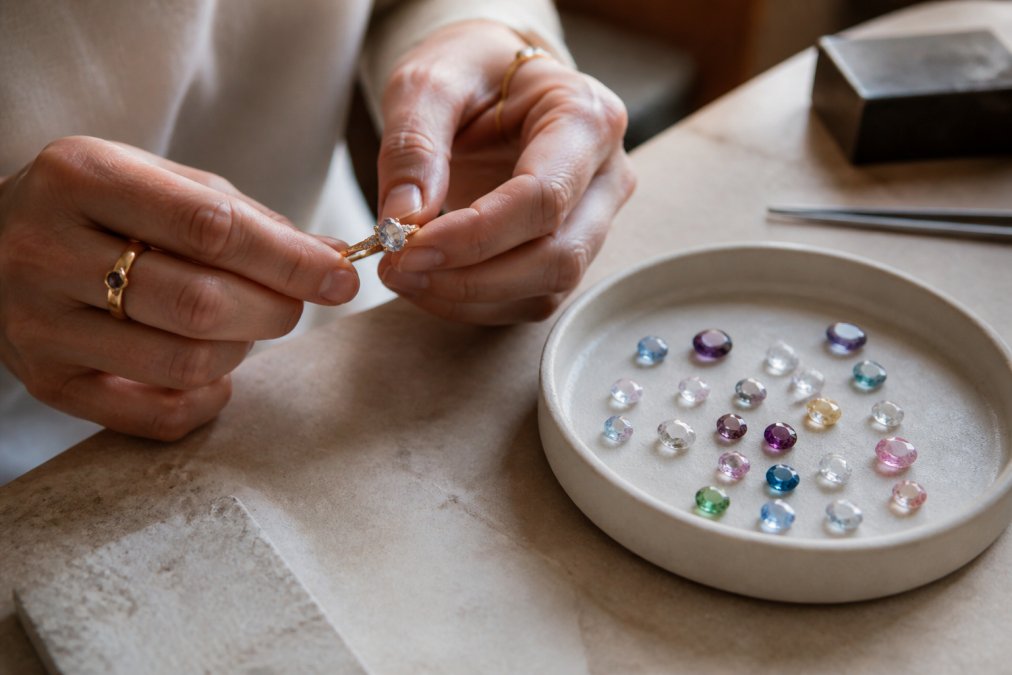
Here's how the main options stack up in practice:
| Option | Hardness (Mohs) | Toughness | Best For | Watch Out For |
|---|---|---|---|---|
| Sapphire / ruby | 9 | Excellent | Daily wear, colour | Can chip at sharp corners |
| Moissanite | 9.25 | Very good | Brilliance on a budget | Distinctive double-refraction sparkle |
| Lab-grown diamond | 10 | Good | Traditional look, ethics | Cleavage planes still chip |
| Natural coloured gemstone | Varies (7-8) | Moderate to good | One-of-a-kind character | Needs protective setting |
| Opal / pearl / moonstone | 5.5-6.5 | Low | Occasional wear | Scratches and cracks easily |
Cost, Customisation, and Long-Term Value
Cost comparison is where most buyers focus, and it's the least important variable over a decade. A cheaper stone that chips in year two costs more than a tougher stone that lasts. Compare not the sticker price but the cost per year of wear: stone, setting, insurance premiums and realistic replacement interval.
A useful way to frame it:
- Upfront cost: the stone, the metal, the setting labour and any bespoke design fee
- Annual carrying cost: insurance premium, professional inspection, occasional re-polishing
- Replacement risk: how likely the stone is to need replacing, and at what interval
- Resale or reset value: whether the stone can be moved into a new band or sold on
Two Australian-specific points worth knowing before you commit:
- GST is included in quoted retail prices, so a quote of $4,000 already contains the 10% tax. If you're comparing an overseas quote, add GST and any customs duty before you treat the numbers as equivalent.
- Bespoke pieces are generally non-refundable once the stone is set, because the maker can't resell a one-off. Ask for the cancellation terms in writing before paying a deposit.
How the Setting Changes the Wear Life of the Stone
The setting is not a style choice; it is the stone's first line of defence. A well-chosen setting adds years to a soft stone, and a poorly chosen one shortens the life of a hard stone.
- Bezel: a metal rim fully encircles the girdle. Best protection for opal, pearl, moonstone and emerald. Slightly reduces light entry, so it suits cabochons and lower-domed cuts.
- Halo: a ring of smaller stones around the centre. Protects the girdle from side impacts and adds apparent size, but the small stones themselves need checking.
- Low-profile prong: sits close to the finger, so the stone is less likely to catch. A reasonable compromise for sapphire and moissanite.
- Tall cathedral prong: maximum light and apparent size, minimum protection. Fine for occasional wear, risky for daily wear.
- Channel and flush: the stone sits level with the metal. Excellent for wedding bands and for anyone who works with their hands.
The Appeal of Handcrafted Gemstone Rings Australia
Handcrafted gemstone rings Australia buyers seek are usually about provenance as much as appearance. Knowing who made a piece, and where the stone came from, changes how you feel wearing it.
How to Care for Gemstone Rings: A Simple Maintenance Routine
Caring for gemstone rings comes down to three habits: remove before risky activity, clean gently and regularly, and inspect the setting monthly. Skip one and wear accelerates.
A simple routine:
- Remove the ring before gym sessions, gardening, cleaning and swimming
- Wipe the stone with a soft, dry cloth after wearing
- Clean with lukewarm water and a drop of mild dish soap, using a soft brush
- Dry fully before storing
- Inspect prongs and bezel edges monthly for looseness or wear
- Book a professional check and re-polish once a year
Insurance and Appraisal Challenges for Non-Traditional Stones
Insuring a non-traditional stone is harder than insuring a diamond, because valuation is less standardised. Diamond pricing has deep, published comparables; coloured gemstones do not. Two sapphires of the same carat weight can differ in value by a factor of several, depending on origin, treatment, colour saturation and cut. That variance makes insurers cautious.
Why Insurers Treat These Rings Differently
Most Australian home and contents policies include a jewellery sub-limit, commonly a few thousand dollars, and require specified item cover above it. A specified item is listed individually with an agreed value, supported by a valuation. Without that, a claim is capped at the sub-limit regardless of the ring's worth.
Three practical consequences follow:
- Lab-grown stones are usually insured for replacement cost, not for the price paid. If you paid a premium for a branded lab-grown stone, expect the payout to reflect the current market replacement price, which may be lower.
- Treated stones (heated sapphire, fracture-filled emerald, oiled emerald) are often excluded or require a specific endorsement. Disclose treatment in writing at the time of cover.
- Composite and assembled stones, a thin slice of opal or sapphire glued to a backing, are frequently excluded outright. If your ring contains one, ask the insurer to confirm cover in writing.
What a Usable Valuation Must Contain
A one-line "sapphire ring, $6,000" is not a valuation. One that supports a claim should specify:
- Stone type and variety (for example, natural blue sapphire, not just "sapphire")
- Carat weight to two decimal places
- Cut, shape and dimensions in millimetres
- Colour using a recognised descriptive scale, and clarity
- Treatment status, heated, unheated, fracture-filled, oiled, or none
- Origin if known, and whether it is certified
- Metal type and purity (for example, 18ct white gold, platinum 950)
- Replacement basis, retail replacement value, not second-hand or auction value
- Valuer's name, qualifications and signature, plus the date
Metal Compatibility, Repairs and the Insurance Link
Metal choice affects both how long the ring lasts and how a claim is settled. Softer metals like 18ct yellow gold wear faster against a hard stone, so prongs thin and the stone works loose. Platinum is denser and holds a setting more securely over decades, which matters for a stone with sharp corners or a high crown.
- Is the repair covered? Accidental damage cover usually handles a chipped stone or a bent setting. Wear and tear is almost always excluded, so a prong that simply wore thin over ten years is typically your cost, not the insurer's.
- Will the insurer pay for a like-for-like stone? If the original stone is no longer available, the insurer may substitute a comparable stone. Ask in advance whether the policy allows you to choose the replacement, or whether the insurer's preferred supplier decides.
Finding Your Stone River Gems Alternative: What to Look For
The right alternative comes down to four questions: how often you'll wear it, your colour preference, what setting protects the stone, and who made it. Answer honestly and the choice narrows fast.
What to look for in a maker:
- Transparency about stone origin and whether it's natural or lab-grown
- Willingness to explain the Mohs rating and toughness of any stone they sell
- Setting advice matched to your lifestyle, not just aesthetics
- A clear resizing and resetting policy
- Documentation for insurance and appraisal
Frequently Asked Questions
What makes a gemstone durable enough for an everyday ring?
Durability comes down to hardness and toughness. The Mohs scale rates scratch resistance, so stones like sapphire (9) and diamond (10) handle daily knocks best. But hardness alone isn't enough: a stone also needs good toughness to resist chipping. Emerald, for example, is hard but brittle. For a ring you'll wear constantly, look for a stone rated 7 or above on the Mohs scale, set in a protective setting that shields the edges.
Are handcrafted gemstone rings from Australian makers worth the higher price?
The price reflects the work behind each piece. A handcrafted ring is made in small batches, often by a single jeweller who selects and sets the stone themselves. That means no mass production, no repetition, and a piece you won't see on anyone else. You're paying for the maker's time, the quality of the stone, and the fact that the design won't be churned out in the thousands. For many buyers, that individuality is the whole point.
How do I care for a gemstone ring so it lasts?
Remove your ring before showering, swimming, cleaning, or applying lotions and perfumes. Most gemstones can be cleaned with warm water, a drop of mild dish soap, and a soft toothbrush, but porous stones like opal or pearl need gentler handling. Store pieces separately in a soft pouch to avoid scratches. Check the setting every few months for loose prongs, and have a jeweller inspect it once a year. A little routine goes a long way.
What should I know about insuring a ring with a non-traditional stone?
Insurers often value a ring based on its replacement cost, which can be tricky with one-of-a-kind or coloured stones. Get a written appraisal from a qualified gemmologist that details the stone type, carat weight, cut, colour, and clarity. Keep your receipt and any certification. Some policies may exclude certain softer stones from accidental damage cover, so ask specifically about your stone type before you commit. It's worth the extra paperwork.
Choosing an alternative ring is really a question of matching stone toughness to how you actually live, not how you imagine you'll live. Choux Fleur Designs makes small-batch, one-of-a-kind gemstone jewellery, handcrafted in Australia with no mass production or repetition, so each piece is designed to be worn every day and kept forever. If you want a ring built around a specific stone rather than a catalogue number, search the Choux Fleur Designs collection and find the piece that's yours.