

Unique Gemstone Rings for Special Occasions
Table of Contents
- Why Unique Gemstone Rings for Special Occasions Stand Apart
- Durable Gemstones for Everyday Wear and Special Moments
- How to Style Gemstone Rings for Different Occasions
- Choosing the Right Gemstone and Metal Type
- Ethical Sourcing and Handcrafted Quality
- Gemstone Jewellery Care Guide for Long-Lasting Sparkle
- Ring Sizing and Resizing: What to Know Before You Buy
- Conclusion
- Frequently Asked Questions
Last Updated: September 20, 2026
Why Unique Gemstone Rings for Special Occasions Stand Apart
A mass-produced ring is made thousands of times; unique gemstone rings are made once. That fact shapes how it looks, wears and feels on the hand.
The Difference Between Mass-Produced and One-of-a-Kind
Mass-produced jewellery starts with a mould and a target unit cost: stones sorted into matched parcels, settings cast in bulk, the finished ring one of hundreds.
Durable Gemstones for Everyday Wear and Special Moments
Some gemstones handle daily wear well; others are better saved for occasions. The deciding factor is hardness on the Mohs scale.
Mohs Hardness Ratings for Daily vs Occasional Wear
| Gemstone | Mohs Hardness | Daily Wear | Best For |
|---|---|---|---|
| Diamond | 10 | Excellent | Everyday and occasion |
| Sapphire | 9 | Excellent | Everyday and occasion |
| Ruby | 9 | Excellent | Everyday and occasion |
| Moissanite | 9.25 | Excellent | Everyday and occasion |
| Emerald | 7.5-8 | Careful wear | Occasional, protected settings |
| Morganite | 7.5-8 | Careful wear | Occasional wear |
| Aquamarine | 7.5-8 | Careful wear | Occasional wear |
| Tourmaline | 7-7.5 | Careful wear | Occasional wear |
| Opal | 5.5-6.5 | Delicate | Occasional, low-contact wear |
| Sunstone | 6-6.5 | Delicate | Occasional wear |
How to Style Gemstone Rings for Different Occasions
Styling a gemstone ring is a matching exercise: colour temperature, scale and metal tone against the outfit and the event.
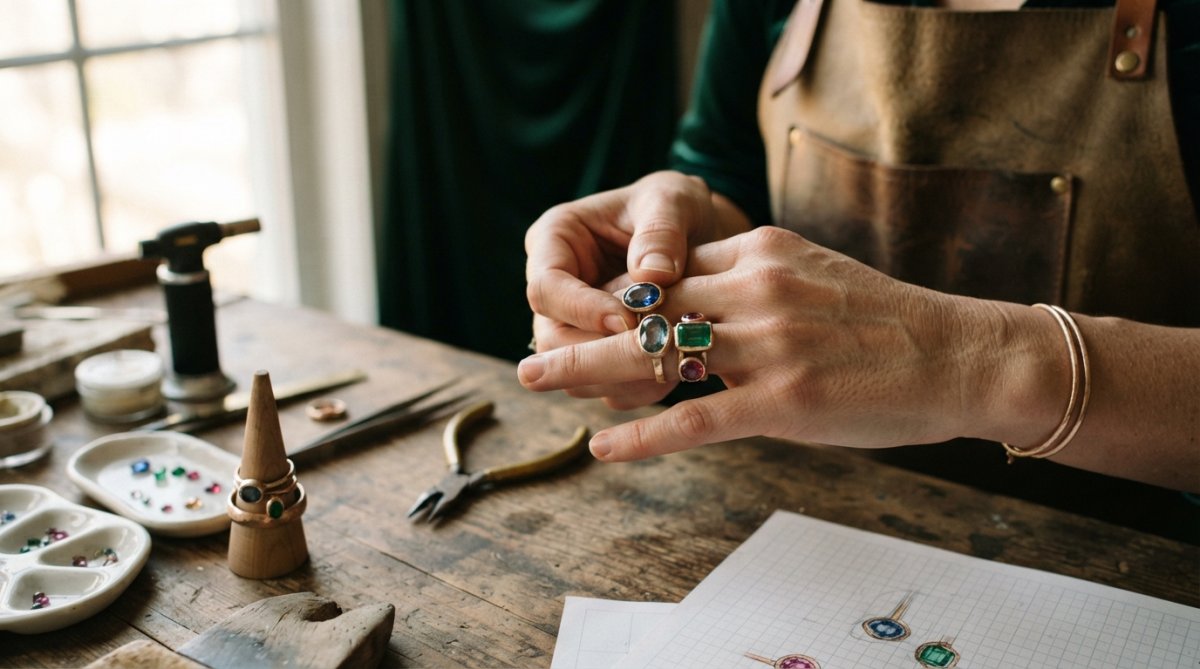
Match the ring to the event, not just the outfit
- Black-tie or formal evening: one sculptural ring on the right hand, or a single emerald, ruby or sapphire on the left. Keep other jewellery minimal so the stone is the focal point; a high-profile setting catches candlelight better than a flat bezel.
- Cocktail or milestone party: a bold cocktail ring works when the rest of the look is restrained. With a patterned dress, choose a stone in a solid colour drawn from the pattern rather than a contrasting one.
- Wedding guest: avoid white or near-white stones that compete with the bride. A coloured gemstone, sapphire, morganite, aquamarine, reads as intentional and photographs well.
- Workplace or daytime event: a slim band with a smaller stone, or a two-ring stack, sits under a sleeve and does not catch on keyboards or lanyards.
- Anniversary dinner: a ring echoing the original engagement stone (same family, different cut) creates a visual link without repeating the piece.
Colour temperature: the rule that does most of the work
Stones and metals sit on a warm-to-cool spectrum. Keeping them on the same side is the fastest way to make a stack look deliberate.
- Cool palette: white gold or platinum with aquamarine, sapphire, tanzanite or blue topaz. Reads sharp and modern against grey, navy, black and cool-toned skin.
- Warm palette: yellow gold or rose gold with morganite, ruby, sunstone, citrine or peach tourmaline. Reads soft and romantic against cream, olive, rust and warm-toned skin.
- Mixed palette: to mix metals, anchor the stack with one stone that bridges both, a green sapphire or parti-coloured tourmaline carries both warm and cool tones.
Scale and finger proportion
A ring balanced on one hand can look lost or heavy on another. As a general guide:
- Short fingers suit elongated cuts, oval, marquise, pear, because the vertical line lengthens the finger.
- Long fingers can carry wide bands, cluster settings and large cushion or emerald cuts.
- Wide bands visually shorten the finger; choose a thinner band with a taller setting instead.
Stacking without damage
Stacks look best when rings share a metal or colour family, but they must be physically compatible. Hard stones scratch soft ones over months of contact: a diamond or sapphire worn against an opal, pearl or sunstone dulls the softer stone, and the damage cannot be polished out. Separate the soft stone onto another finger, or place a plain metal spacer band between them.
Symbolism as a styling layer
Choosing a stone for its meaning gives the piece a reason to be worn at that event. Sapphire is associated with loyalty and wisdom, ruby with passion and protection, emerald with renewal and growth, aquamarine with calm and clarity, a useful tiebreaker when two rings look equally good.
Choosing the Right Gemstone and Metal Type
The metal you choose changes how a gemstone reads, how the ring wears over decades, and how easily it can be resized, the decisions you live with after the purchase.
Colour matching: the starting point
White gold and platinum cool warm stones and make icy blues and greens pop. Rose gold warms everything, suiting morganite, ruby and sunstone. Yellow gold is the classic partner for emerald and sapphire, flattering deeper skin tones and strongly saturated stones.
Wear characteristics: what changes over time
- White gold is rhodium-plated. The plating wears through on high-contact areas, the underside of the band and setting edges, and needs periodic re-plating. Underneath, white gold is a yellow-gold alloy, so an unplated ring shows a faint warm tone.
- Yellow gold and rose gold hold their colour without plating because the alloying metals (copper for rose, silver and copper for yellow) are mixed through the metal. Rose gold's copper also makes it marginally harder than yellow gold of the same karat.
- Platinum is denser and heavier than gold. It does not wear away like gold; it develops a soft matte patina from small surface displacements, which many prefer and which polishes back to a high shine. It is also naturally hypoallergenic.
- Palladium sits between white gold and platinum on price and weight, and needs no rhodium plating.
- Recycled gold performs identically to newly mined gold because gold is an element; the environmental difference comes from avoiding new mining.
Hardness versus toughness: the distinction that decides the setting
Metal hardness and gemstone hardness are different scales that interact: a harder metal holds a setting's shape longer, which matters for stones with fragile edges.
- Gold karat affects hardness: 18K is softer than 14K because it contains more pure gold. A 14K setting resists knocks and claw wear better than an 18K setting of the same design, at a slight cost to colour depth.
- Platinum's density holds claws tightly, which is why it is often chosen for emeralds and other included stones.
- For a stone with weak cleavage or visible inclusions, emerald is the classic example, a bezel or halo of small hard stones distributes impact away from vulnerable edges better than four thin claws.
Resizing: the constraint nobody mentions at the counter
Metal choice affects how easily a ring can be resized later, worth asking about before you commit.
- Plain gold and platinum bands can usually be resized by a couple of sizes. Platinum needs a higher-temperature technique and a specialist jeweller, so expect a longer turnaround.
- Full eternity settings, channel-set stones and continuous engraved patterns often cannot be resized without rebuilding the band, because there is no plain metal section to cut and rejoin.
- Mixed-metal designs with inlays or two-tone bands are harder to resize cleanly because the join line must be matched.
- Titanium and tungsten rings are generally not resizable and must be replaced if the size changes.
A practical decision order
- Choose the stone first, based on hardness and how often you plan to wear the ring.
- Choose the setting style second, based on the stone's toughness and the protection it needs.
- Choose the metal third, based on colour preference, skin sensitivity, resizing flexibility and acceptable maintenance.
That order keeps aesthetics from overriding structure, which is where most regretted purchases start.
Ethical Sourcing and Handcrafted Quality
Ethical sourcing means knowing where a stone came from and how it was cut, not just that it is conflict-free on paper. Traceability is the real test.
Handcrafted quality shows up in details you can inspect:
- Claws that sit flush against the stone rather than catching on fabric
- Symmetrical settings that hold the gem level, not tilted
- Smooth interior finishes, so the ring sits comfortably
- A hallmark or maker's mark identifying the piece
Gemstone Jewellery Care Guide for Long-Lasting Sparkle
Most gemstone damage comes from cleaning, not wearing: the wrong method dulls a stone or loosens a setting faster than daily use would.
A simple care routine:
- Remove rings before swimming, showering, gardening or using chemicals
- Store each piece separately in a soft pouch to prevent scratching
- Clean with lukewarm water, a drop of mild dish soap and a soft brush
- Dry with a lint-free cloth before storing
- Have settings checked yearly if you wear the ring daily
Ring Sizing and Resizing: What to Know Before You Buy
Sizing is where online jewellery purchases go wrong most often. Fingers change size with temperature, time of day and season, so measure more than once.
Conclusion
Buying a unique gemstone ring means you cannot compare it line by line against a catalogue. Check what matters: stone hardness for how you will wear it, metal choice for how it flatters the gem, sourcing for where it came from, and sizing terms before you commit.
Frequently Asked Questions
How do I choose a gemstone ring for a special occasion?
Start with the occasion and your personal style. For a formal event, a statement sapphire or emerald in a white gold setting works well. For a more relaxed celebration, consider a stack of smaller stones in mixed metals. Think about your outfit's colour palette and whether you want the ring to stand out or complement. Also check the gemstone's durability: opals and pearls are better for occasional wear, while sapphires and rubies handle regular use. Always ask about sourcing and certification before buying.
Are gemstone rings suitable for daily wear?
Some are, some aren't. It depends on the gemstone's hardness on the Mohs scale. Sapphires (9) and rubies (9) are durable enough for everyday wear. Emeralds (7.5-8) need more care because they can chip. Opals (5.5-6.5) and pearls (2.5-4.5) are best saved for special occasions. If you plan to wear a ring daily, choose a setting that protects the stone and remove it during heavy tasks. A handcrafted piece with a secure setting will last longer.
What makes a gemstone ring 'unique' compared to mass-produced jewellery?
Unique gemstone rings are typically handcrafted in small batches, meaning no two pieces are exactly alike. Each stone has its own colour, inclusions, and character. Mass-produced jewellery uses uniform stones and repeatable designs. A one-of-a-kind ring reflects the maker's artistic choices in proportion, contrast, and metalwork. Look for signs of handcrafting: slight variations in the setting, a maker's mark, and a story behind the stone's origin. These details add heirloom quality.
How should I care for my gemstone jewellery to ensure it lasts?
Store each piece separately in a soft pouch or lined box to avoid scratches. Clean with lukewarm water and a mild dish soap using a soft brush, but avoid harsh chemicals, ultrasonic cleaners, and steam for porous stones like opals, emeralds, and pearls. Remove rings before swimming, exercising, or applying lotions. Check settings every few months for loose prongs. For deeper cleaning or resizing, consult a jeweller. Following a gemstone jewellery care guide keeps your piece looking new for years.