

Why Choose Small Batch Gemstone Jewelry
Table of Contents
- What Defines Small Batch Gemstone Jewelry
- The Benefits of Handmade Gemstone Jewellery Over Mass Production
- Ethical Gemstone Sourcing Australia: Why Provenance Matters
- How Small Batch Production Preserves Design Integrity
- A Buyer's Quality Assurance Checklist for Gemstone Pieces
- Caring for Handcrafted Gemstone Pieces
- Conclusion
- Frequently Asked Questions
Last Updated: September 6, 2026
Small batch gemstone jewelry is a deliberate alternative to mass production, offering individually crafted pieces that prioritise material integrity, design intention, and ethical provenance over volume. Choosing small batch gemstone pieces means investing in adornment that is made to be worn daily and kept for decades, rather than discarded when trends shift. At Choux Fleur Designs, we have built our entire practice around this philosophy, creating one-of-a-kind necklaces that balance colour, proportion, and contrast. This guide explains why small batch gemstone jewelry offers superior craftsmanship and longevity, and how to verify the quality of what you are buying.

The difference between a considered piece and a mass-produced accessory often comes down to decisions made before the first bead is strung. Below, we will walk through what defines this approach, how to assess ethical sourcing, and the specific quality checks that separate heirloom pieces from those that fall apart within months.
What Defines Small Batch Gemstone Jewelry
Small batch gemstone jewelry is jewellery produced in limited, intentional production runs, often as one-of-a-kind pieces, rather than manufactured in high volumes for broad retail distribution. Each piece in a small batch is typically handcrafted, meaning a single maker selects the stones, controls the assembly, and inspects the finished item before it reaches the buyer. This stands in direct contrast to the supply chain of mass-produced accessories, where identical designs are cast and assembled in large quantities to minimise cost per unit.
A defining characteristic is the absence of repetition. Where a commercial line might produce hundreds of identical necklaces, a small batch approach embraces variation in natural stone, colour, and texture. This low-risk production method allows independent designers to experiment with unusual combinations and gemstone-specific sourcing without committing to a large inventory that may not sell.
The Benefits of Handmade Gemstone Jewellery Over Mass Production
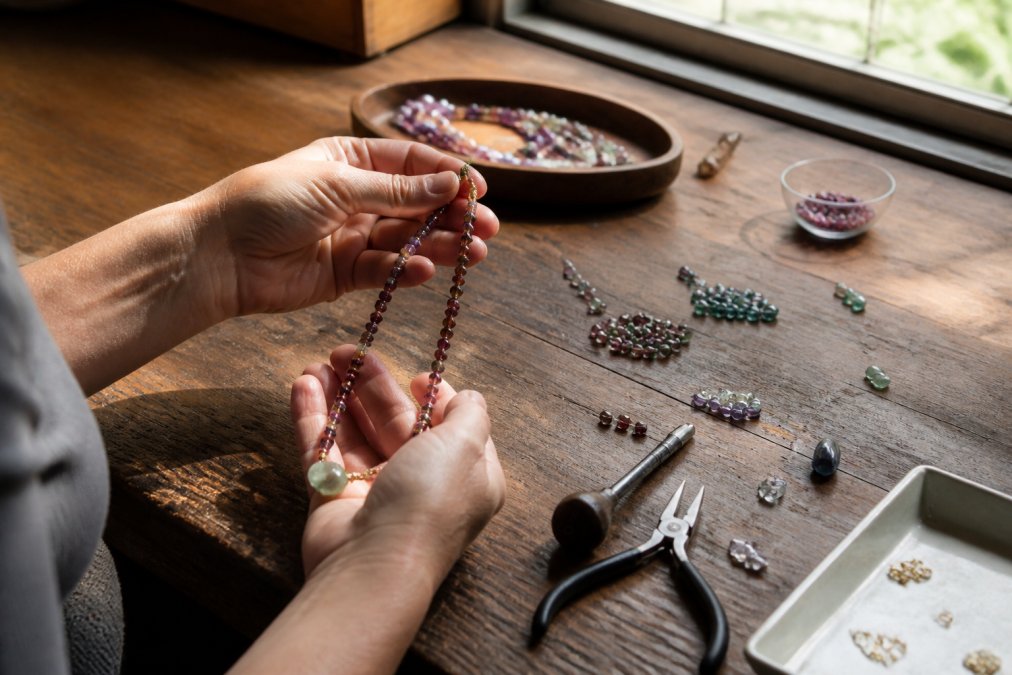
The benefits of handmade gemstone jewellery over mass production centre on durability, uniqueness, and the integrity of the materials used. When a piece is assembled by hand, each stone setting and knot is individually checked, which is why handcrafted items often outlast their factory-made counterparts. The personal nature of this work also supports independent designers and sustainable practices, reducing the environmental toll of large-scale casting and finishing.
Mass-produced jewellery frequently relies on plated metals and lower-grade stones to keep wholesale pricing competitive. A handcrafted approach, by contrast, prioritises design integrity and material sourcing, using genuine stones that are selected for their hue and energy rather than their uniformity. For the wearer, this means a piece that not only looks different from anything else but also carries the subtle variations that mark it as authentic and alive.
Quality Control and Attention to Detail
The most significant advantage of small batch work is the level of quality control possible when a maker handles every piece. In a factory, a necklace might pass through dozens of hands, with no single person accountable for the final result. In a small studio, the maker inspects the clasp, the wire wrapping, and the balance of the stones before the piece is ever photographed.
A common failure point in cheaper jewellery is the clasp and the stringing material. Handcrafted pieces typically use more strong findings, such as gold-filled or vermeil clasps, and are strung on materials designed to withstand daily wear. When you buy a one-of-a-kind piece, you are paying for the maker's reputation, which is why attention to detail is not an afterthought but the core of the process.
Ethical Gemstone Sourcing Australia: Why Provenance Matters
Ethical gemstone sourcing in Australia is not a single certification but a layered system of legal compliance, supply-chain diligence, and material choice. For the buyer, understanding this framework is the difference between a marketing claim and a verifiable practice.
The Regulatory Baseline: What Australian Law Requires
Any gemstone or jewellery sold in Australia must comply with the Competition and Consumer Act 2010, which prohibits false or misleading representations about the origin, quality, or characteristics of goods (legislation.gov.au). This means a designer cannot legally claim a stone is 'ethically sourced' or 'Australian' without a reasonable basis. However, this law sets a floor, not a ceiling. It does not mandate a specific certification for coloured gemstones, unlike the Kimberley Process for rough diamonds, which is enforced in Australia through the Customs (Prohibited Imports) Regulations 1956.
For coloured gemstones, sapphires, opals, emeralds, and the like, there is no equivalent international tracking system. This is the core challenge of gemstone-specific sourcing. A designer must therefore rely on direct relationships with cutters or miners, or on documentation from suppliers who can trace the stone back to a specific region or mine.
The Australian Advantage: Opal and Sapphire
Australia is one of the world's most significant sources of precious gemstones, which gives local designers a distinct advantage. The majority of the world's precious opal comes from fields in South Australia, New South Wales, and Queensland (australianmuseum.net.au). Similarly, the Gemfields in Central Queensland produce some of the world's finest sapphires, often found in the alluvial deposits near Anakie.
When a designer sources directly from these regions, the provenance chain is short and verifiable. For example, a buyer can ask a maker whether their sapphires come from the Lava Plains or the Fossil Bluff fields, and a reputable designer will be able to answer with that level of specificity. This is a level of traceability that is nearly impossible for a mass-market producer importing from multiple unknown cutters in Thailand or India.
The Import Reality: Where the Gaps Appear
Most coloured gemstones used in Australian jewellery are still imported, primarily from cutting centres in Jaipur, Chanthaburi, and Sri Lanka. The ethical risk is not always the mining itself, but the lack of documentation as stones pass through multiple intermediaries. A common pattern is for a stone to be mined in one country, cut in another, and sold in a third, with each step erasing a layer of provenance.
To navigate this, many independent designers adopt a 'known source' policy. They will only buy from a small number of cutters they have visited, or they will favour stones that can be traced to a specific cooperative mine. Others sidestep the issue entirely by incorporating rare vintage and reclaimed beads into their work. This approach eliminates the demand for newly mined stones, reduces the environmental footprint, and guarantees that no new mining-related conflict is funded.
How to Verify a Designer's Sourcing Claims
A practical way to test a designer's commitment is to ask for the stone's origin at the level of a region or field, not just a country. If they cannot provide that, ask whether they use recycled or vintage stones. If they do, that is a verifiable, concrete answer. If they claim to use 'ethically sourced' stones but cannot name the supplier or the region, that is a red flag under Australian consumer law, which requires a reasonable basis for such claims.
Ultimately, the most transparent designers will publish their sourcing policy on their website or provide it on request. This is not just a matter of ethics; it is a matter of legal compliance and brand integrity. For the buyer, it is the single most reliable indicator that the piece you are buying has a provenance you can trust.
How Small Batch Production Preserves Design Integrity
Small batch production preserves design integrity by allowing the maker to follow the material rather than a production template. When you are making one piece at a time, you can respond to the character of each stone, adjusting the composition to achieve the best balance of colour and proportion. This flexibility is what enables independent designers to create modern heirlooms that feel personal and intentional.
This contrasts sharply with the constraints of mass production, where a design must be standardised to be profitable. In a factory setting, variation is a defect; in small batch work, variation is the point. The result is a piece that expresses the designer's artistic voice without compromise, which is why small batch gemstone jewelry often appeals to collectors and art enthusiasts who value individuality over ubiquity.
The Technical Production Lifecycle
Understanding the technical production lifecycle explains why small batch pieces take longer and cost more. The process typically begins with material sourcing, where the designer selects stones based on colour, cut, and durability. Next comes the design phase, where the pieces are laid out and adjusted, followed by the stringing or setting work itself, and finally the finishing and inspection.
| Production Stage | What Happens | Typical Time | Quality Focus |
|---|---|---|---|
| Material sourcing | Selecting genuine stones and findings | Days to weeks | Ethical provenance, colour matching |
| Design and layout | Arranging stones for balance and proportion | Hours per piece | Composition, contrast |
| Hand assembly | Stringing, knotting, and setting | 1-3 hours per piece | Secure clasps, durable stringing |
| Finishing and inspection | Checking every stone and finding | 15-30 minutes | Defect removal, final polish |
The absence of a production line means that a single piece might take several hours of focused work. This is the reason that handcrafted jewellery commands a higher price point than mass-produced accessories, and it is also the reason it lasts.
A Buyer's Quality Assurance Checklist for Gemstone Pieces
Before purchasing any handcrafted gemstone piece, use this quality assurance checklist to assess whether the item will hold up to daily wear. First, examine the clasp and findings: they should be gold-filled or solid metal, not cheap plated base metal that will flake. Handcrafted pieces typically use more strong findings, such as gold-filled or vermeil clasps, and are strung on materials designed to withstand daily wear. Second, check the stringing material, whether it is silk, cord, or wire, and ask if it is suitable for the weight of the stones.
Third, inspect the stones for visible flaws or cracks, and ask the maker about their durability. Softer stones, such as turquoise or opal, require more careful wear than harder stones like quartz. Fourth, ask about the return policy and what happens if a piece arrives damaged or needs repair. Finally, request additional photos or videos if you are buying online, and ask about the specific stones used if you are concerned about colour matching your skin tone.
Caring for Handcrafted Gemstone Pieces
Caring for handcrafted gemstone pieces requires a gentler routine than commercial jewellery, because natural stones and hand-finished metals respond differently to chemicals and abrasion. To keep a piece looking its best, put it on after applying perfume, lotion, or hairspray, as these products can dull the finish of both stones and metals. Remove the piece before swimming, showering, or exercising, as prolonged moisture and sweat can weaken stringing materials and loosen settings.
For cleaning, use a soft, dry cloth and warm soapy water sparingly, avoiding ultrasonic cleaners which can damage softer stones (gia.edu). Store each piece separately in a soft pouch or jewellery box to prevent scratching, and avoid leaving it in direct sunlight, which can fade certain stones over time. With this level of care, a well-made small batch piece will last for decades, which is the entire point of choosing a modern heirloom over a disposable accessory.
Conclusion
Choosing small batch gemstone jewelry means rejecting the disposable cycle of fast fashion in favour of pieces designed to be worn every day and kept forever. The challenge lies in finding a maker you trust, one who can document their sourcing, stands behind their craftsmanship, and offers pieces that reflect your personal style rather than a passing trend. At Choux Fleur Designs, we create one-of-a-kind gemstone jewellery, meticulously handcrafted in Australia for those who appreciate artistic and intentional adornment. Explore the collection to find a piece that balances colour, proportion, and contrast, made to become your own modern heirloom.

Frequently Asked Questions
What defines small batch gemstone jewellery compared to mass-produced pieces?
Small batch gemstone jewellery is produced in limited quantities, often one-of-a-kind, rather than in large factory runs. Each piece is handcrafted and individually finished, meaning no two items are exactly alike. This approach allows for meticulous quality control, design flexibility, and the use of distinctive, high-quality gemstones. Unlike mass-produced accessories, small batch pieces are created with intention and artistry, making them modern heirlooms rather than disposable fashion items.
Is small batch jewellery more sustainable than mass-produced alternatives?
Yes, small batch jewellery is generally more sustainable. It reduces overproduction and waste, as pieces are made to order or in limited runs. By supporting independent artisans, you are choosing a supply chain that values quality and longevity over volume, which is a more responsible choice.
What are the benefits of supporting independent jewellery artisans?
Supporting independent artisans means investing in original design and superior craftsmanship. You receive a unique piece with a story, rather than a mass-produced item. It also supports small business operations and sustainable practices. The result is a high-quality, durable item you will treasure for years, made with care and ethical standards.
How do I care for my handcrafted gemstone pieces to ensure they last?
To keep your handcrafted pieces looking their best, store them separately in a soft pouch or jewellery box to prevent scratching. Avoid exposing them to harsh chemicals, perfume, or lotion, which can dull gemstones. Clean them gently with a soft, damp cloth and mild soap if needed. It is also wise to remove your jewellery before swimming or exercising to protect the stones and clasps. With proper care, your pieces will remain beautiful for generations.