

How to Verify Authentic Australian Handcrafted Jewelry
Table of Contents
- Start With the Hallmarks on Australian Gold Jewellery
- Handmade vs Hand-Assembled Jewellery: Why the Difference Matters
- How to Spot Dropshipped Jewellery Before You Buy
- Test for Solid Metals: Magnet and Scratch Checks at Home
- Verify Local Production and the Australian Made Logo
- Digital Provenance, Ethical Sourcing and Online-Only Purchases
- Questions to Ask Before You Buy Australian Handcrafted Jewelry
- Where Genuine Craft Actually Shows
- Frequently Asked Questions
Last Updated: September 11, 2026
Start With the Hallmarks on Australian Gold Jewellery
The fastest way to verify authentic Australian handcrafted jewelry is to examine the hallmarks stamped into the metal. These marks tell you the metal's purity, origin, and often the maker.

A hallmark is a stamped or laser-engraved mark indicating precious metal content and often the maker's identity. On Australian gold jewellery, look for a karat stamp (9k, 14k, 18k), a maker's mark, and a fineness number such as 375, 585, or 750.
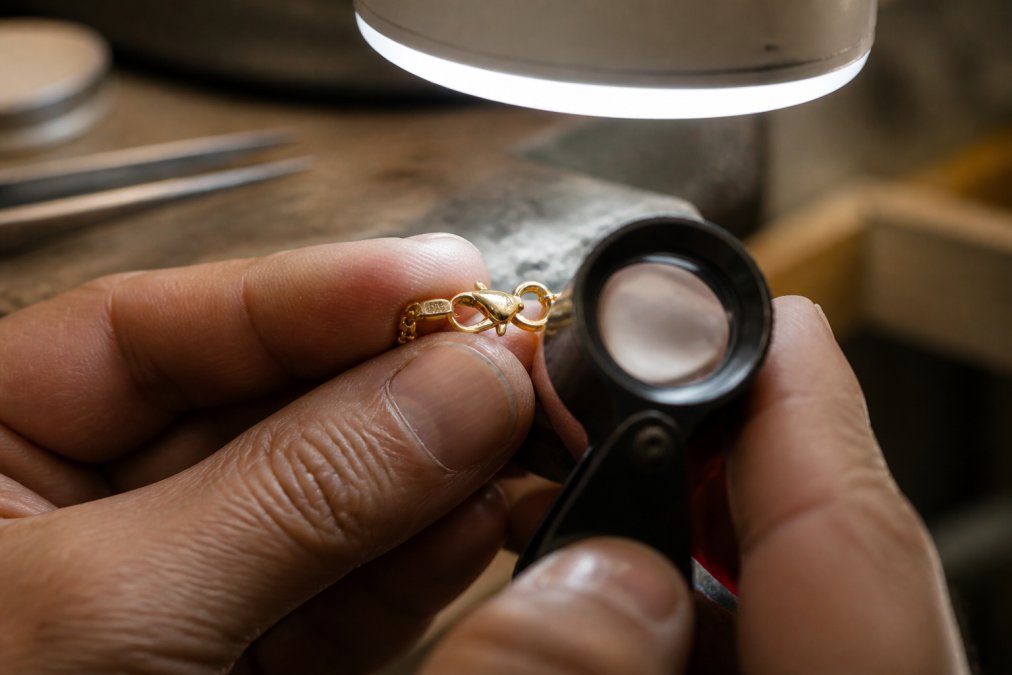
What a Karat Stamp Actually Tells You
A karat stamp is a legal declaration of metal purity. 9k gold contains 37.5% pure gold, 14k contains 58.5%, and 18k contains 75%, fineness marks 375, 585, and 750.
If a piece claims to be solid gold but carries no karat stamp, treat that as a serious warning sign. Reputable makers stamp every piece, it is their signature on the metal.
The Kangaroo Mark and Australian Assay Office Standards
The kangaroo mark is a voluntary stamp some Australian makers use to signal local production, but it is not a government guarantee. Australia has no single national assay office; precious metal claims fall under Australian Consumer Law, which prohibits false or misleading representations.
That means the karat stamp is the enforceable claim. If a piece is stamped 18k but tests as gold-plated, the seller has broken the law. ACCC guidance on false or misleading claims sets out the penalties for misrepresenting product origin and composition.
Handmade vs Hand-Assembled Jewellery: Why the Difference Matters
Handmade jewellery is shaped from raw materials at the bench: metal is cut, filed, soldered, and finished by hand. Hand-assembled jewellery joins pre-manufactured components. Both can be legitimate, but only one reflects genuine craft.
"Handcrafted" has no legal definition in Australia, so a seller can describe a piece as handcrafted even if they only attached a pre-made clasp to a pre-made chain.
Where Casting, Soldering and Finishing Happen
Ask where each stage of production occurred. A genuinely bench-made piece involves casting (or forging), soldering, and finishing in the same workshop.
A high price does not guarantee bench work, price reflects brand positioning as much as labour.

How to Spot Dropshipped Jewellery Before You Buy
Dropshipped jewellery is mass-produced stock shipped from overseas warehouses under an independent-looking brand. It is the biggest threat to buying authentic Australian handcrafted jewelry, because the storefront looks identical to a real studio's.
The tell is rarely in the product but in the business model: a dropshipper cannot tell you who made the piece, because they have never met them.
Red Flags in Product Photos and Listings
- Identical photos across multiple "different" brands. Reverse-image search the product shot.
- Stock-style white backgrounds with no studio context. Real makers photograph on their own bench.
- No maker's name or story. Just a brand logo and generic copy.
- Suspiciously fast "made to order" claims. Genuine bespoke work takes weeks, not days.
- Shipping from overseas with no local return address.
- Prices that undercut every local maker by a wide margin.
Test for Solid Metals: Magnet and Scratch Checks at Home
Two simple tests separate solid precious metals from plated base metals. Neither is definitive alone, but together they catch most fakes.
The magnet test: Solid gold, sterling silver, and platinum are non-magnetic. A strong pull suggests a steel or nickel core, though trace magnetic metals in some gold alloys mean a weak attraction is not automatically disqualifying.
The scratch test: Gently scratch an inconspicuous area with a fine file. If the metal underneath is a different colour, the piece is plated; solid gold stays gold all the way through.
For anything expensive, get an acid test or a jewellery appraisal from a qualified valuer. An appraisal documents metal purity, gemstone identity, and replacement value, the only test that holds up for a claim.
| Test | What It Detects | Reliability | Best For |
|---|---|---|---|
| Magnet test | Ferrous base metals | Moderate | Quick first check |
| Scratch test | Plating over base metal | Moderate | Visible wear points |
| Acid test | Metal purity (karat) | High | Pre-purchase verification |
| Professional appraisal | Purity, stones, value | Highest | Insurance and high-value pieces |
Verify Local Production and the Australian Made Logo
The Australian Made, Australian Grown logo is a licensed certification mark, not a decorative sticker. It is administered by the Australian Made Campaign Limited (AMCL), which licenses it to businesses whose goods meet the safe harbour provisions in Australian Consumer Law. Knowing what it legally requires, and what it does not, separates a genuine local studio from a brand trading on the word 'Australian'.
The Two Claims Are Not the Same
The logo comes in two forms with different legal thresholds:
- Australian Made, the goods must have been substantially transformed in Australia. The ACCC's safe harbour definition generally treats goods as substantially transformed if the transformation accounts for at least 50% of the total cost of producing the goods, and results in a fundamentally different product. A jeweller who casts, solders, sets, and finishes a ring at an Australian bench will typically meet this; one who imports a finished ring and polishes it will not.
- Product of Australia, a stricter claim. Every significant ingredient or component must come from Australia, and all or virtually all of the production process must occur here. Very few jewellery pieces qualify, because most precious metal stock and many gemstones are imported.
'Designed in Australia' or 'Australian owned' are neither claim, they are marketing, not certification, and carry no safe harbour protection.
How to Check a Licence in Under Two Minutes
AMCL maintains a public register of licensed products and businesses. Before trusting the logo on a listing or swing tag:
- Go to the AMCL website and open the licence search.
- Search the business name, not the product name, licences are issued to businesses, not individual SKUs.
- Confirm the licence is current and the product category matches the piece you are buying.
- If the brand does not appear, the logo is unlicensed and the claim is likely false or misleading.
Unlicensed use of the logo can be reported to the ACCC, because a false country-of-origin representation breaches the Australian Consumer Law prohibition on misleading conduct.
Australian Made Campaign Limited licence search ACCC country of origin claims guidance
What the Logo Does Not Tell You
The logo verifies where a piece was substantially transformed. It does not verify that the piece was made by hand rather than machine, that the maker is an individual rather than a factory, that the gemstones are ethically sourced, or that the metal is recycled or traceable. Treat the logo as one verified data point, not a complete authenticity guarantee.
The Physical Signals That Back It Up
Beyond the logo, look for signals a dropshipper cannot fake:
- A named workshop suburb or street address, not just a capital-city postcode
- Process content filmed at the bench, filings, flux, a soldering torch, half-finished pieces
- A maker who can describe the specific alloy they use and where they buy it
- A studio that appears in person at markets, exhibitions, or open-studio events
A studio-based independent designer shows you the bench, tools, and mess; a dropshipper shows a rendered logo and a stock photo.
Digital Provenance, Ethical Sourcing and Online-Only Purchases
Most verification advice assumes you can hold the piece, tilt it under a lamp, and run a magnet across the clasp. Online buyers cannot. Three things matter when the only evidence is what the seller publishes: digital provenance, the difference between 'Australian made' and 'ethically sourced', and a remote verification workflow.
Digital Provenance: What It Is and What to Ask For
Digital provenance is a documented, transferable record of a piece's history the buyer can access after purchase. A maker can supply:
- The name of the bench jeweller who made the piece, not just the brand
- The date the piece was completed and the batch or job number
- Gemstone origin, treatment status, and the supplier's name
- Metal certification from the refiner, including recycled-content claims if made
- A photograph of the hallmark on the finished piece
Ask for this in writing before you pay.
'Australian Made' Is Not the Same as 'Ethically Sourced'
These two claims are routinely conflated, and the confusion works in the seller's favour. They are legally and practically separate:
- Australian Made is a country-of-origin claim, governed by Australian Consumer Law and licensed by AMCL. It says nothing about how the metal was mined or the gemstones extracted.
- Ethically sourced is a supply-chain claim covering labour conditions, conflict-free gemstones, and environmental practice. It has no single Australian legal definition, so it is only as credible as the documentation behind it.
A piece can be genuinely Australian made and still contain gold from an unknown refinery or sapphires of undocumented origin. If ethical sourcing matters, ask for the refiner's name, the gemstone supplier, and any certification such as a Kimberley Process certificate for diamonds. If the seller cannot name the refiner, the ethical claim is unverified.
The Remote Verification Workflow for Online-Only Buys
Run this in order before you pay. Each step is checkable from a browser.
1. Verify the business, not just the brand.
- Search the business name on the Australian Business Register (ABR) to confirm an active ABN.
- Check the ABN's registered trading name matches the storefront.
- No ABN, or one registered to an unrelated entity, is a red flag.
2. Verify the country-of-origin claim.
- If the 'Australian Made' logo appears, search the AMCL licence register for the business name.
- If the logo is absent, ask directly: was the piece substantially transformed in Australia? Get it in writing.
3. Verify the maker.
- Ask for the name of the bench jeweller and the workshop suburb.
- Request a short video of the piece being handled at the bench. A real maker can film this in minutes; a dropshipper cannot.
- Reverse-image search the product photos. Identical shots across multiple 'different' brands indicate stock imagery.
4. Verify the materials.
- Ask for a close-up photo of the hallmark on the actual piece, not a stock image.
- Confirm the karat stamp matches the listing description.
- Ask for gemstone origin and treatment details in writing.
5. Verify the terms.
- Confirm the return window and who pays return postage.
- Confirm the dispatch timeframe. Genuine made-to-order work takes weeks, not days.
- Confirm the shipping origin. A piece described as Australian made but dispatched from an overseas warehouse is neither.
6. Get it in writing.
- Keep the email thread. Under Australian Consumer Law, a written representation about origin, composition, or materials is enforceable. If the piece does not match the written description, you have grounds for a remedy.
After the Piece Arrives
Remote verification does not stop at checkout. When the parcel lands:
- Inspect the hallmark under a loupe and confirm it matches what was promised.
- Run the magnet test on the clasp or an inconspicuous area.
- Photograph the piece and the hallmark before wearing it, in case you need to make a claim.
- If anything does not match the written description, contact the seller in writing within the return window and cite the specific representation breached.
A maker who stands behind their work will resolve it.
Questions to Ask Before You Buy Australian Handcrafted Jewelry
The right questions expose a fake in under a minute. Ask them in writing so you have a record.
- Who made this piece, and where is your workshop? A real answer names a person and a place.
- What is the karat stamp on this piece? Expect a specific number, not "gold."
- Where were the gemstones sourced, and are they treated? Vague answers mean unknown origin.
- Can you send a photo of the hallmark? A maker will have one on file.
- What is your return policy if the piece doesn't suit? A confident maker offers a clear window.
- Do you offer documentation of provenance? This separates a studio from a reseller.
If any answer is evasive, walk away. There are enough genuine makers that you never need to gamble.
Where Genuine Craft Actually Shows
Buying authentic Australian handcrafted jewelry comes down to one principle: trust the paper trail, not the packaging. Hallmarks, karat stamps, maker names, and provenance documents are the only claims that can be checked.
At Choux Fleur Designs, authenticity is built into how we work. Every piece is handcrafted in Australia in small batches, with no mass production and no repetition. Each is a one-of-a-kind design, made to be worn every day and kept forever. If you want jewellery with a name, a bench, and a story behind it, explore the collection and see the difference for yourself.
Frequently Asked Questions
Does Australian gold jewellery require a hallmark?
Yes. Under Australian Consumer Law and state fair trading rules, gold jewellery sold as a stated karat must carry a stamp matching its actual purity, such as 9k, 14k or 18k. Reputable makers also include a maker's mark or assay office stamp. If a piece claims solid gold but has no karat stamp, treat that as a warning sign and ask the seller for written confirmation of metal purity before buying.
How can I tell if a jewellery brand is dropshipping?
Look for stock photos used across multiple stores, identical listings under different brand names, shipping times of two to four weeks, and no workshop address or maker name. Reputable Australian handcrafted jewelry brands can explain where stones and metals come from. Ask directly where the piece is made and who made it. Vague answers usually mean the item is mass-produced or imported.
What is the difference between handmade and hand-assembled jewellery?
Handmade means the maker shapes, solders and finishes the metal themselves, often from raw sheet or wire. Hand-assembled means pre-made components, such as cast charms or imported chains, are strung or joined together. Both can be well made, but only handmade involves the full bench process. Ask whether the setting was cast elsewhere and whether the chain was bought in. That answer tells you which category you are paying for.
Are there specific markings for precious metals in Australia?
Australian precious metal items typically carry a karat or purity stamp, such as 925 for sterling silver or 9k, 14k and 18k for gold, plus a maker's mark. Some pieces also show an assay office stamp. The Australian Made logo is separate and only applies to goods meeting the legal definition of substantial transformation locally. A karat stamp proves metal purity, not where the piece was made, so check both.
The hardest part of buying handmade jewellery online is trusting a piece you cannot hold. Choux Fleur Designs removes that doubt by making every piece a documented, one-of-a-kind creation, handcrafted in Australia with no mass production and no repetition. Search the collection to find a modern heirloom designed to be worn every day and kept forever.